
“Nu descendant l’escalier n°2” (1912). Here, Marcel Duchamp conveys a sense of mobility and movement (descending a staircase) using a few simple geometric shapes.
In a recent paper (my first, in fact), I argued that the young Harvard macrodynamicist Richard Goodwin was driven by the idea of building a model of economic irregularity – one capable of incorporating the exogenous shocks he linked to technical progress. He shared Frisch’s ambition of giving Schumpeter’s vision of innovation a formal macrodynamic shape, but pursued it through a different route.
Using a simulation of Goodwin’s 1951 nonlinear accelerator model, I argued that its real achievement was not simply to produce self-sustained cycles, but to articulate those internal oscillations with exogenous impulses arising from innovation. What emerges is a mechanism that acts as a genuine “frequency converter” (Goodwin 1951, 8) — think radio tuner or electronic oscillator, where a smooth, steady input signal gets reshaped into a fluctuating, complex output with a different rhythm. In Goodwin’s hands, the point becomes economic: a smooth process of technical change does not remain smooth once it passes through the investment mechanism. It is transformed into cyclical motion. Without mentioning him — and apparently unaware of his work – Goodwin was drawing close to the 1930s engineer Ludwig Hamburger, who had already grasped — without formal simulation — that shocks to nonlinear oscillators alter periods rather than amplitudes (much like in Goodwin’s own frequency converter). Goodwin’s enduring contribution was to give these tools their full economic meaning.
Let’s start with the structure of the model itself, then move on to a few technical points that help make its logic clearer. Technical progress will come in the next post. The payoff is immediate. Once the mechanism is written clearly, the cycle stops looking mysterious. It becomes a small but surprisingly elegant machine. Let me unpack this for you, step by step. Along the way, you’ll find two simulations —one to trace income and capital trajectories in real time, revealing the three distinct income levels and their relentless alternation; the other to witness the frequency converter in full operation.
A Three-Regime Engine
The starting point will be familiar to any Keynesian :

Here is consumption, is income, is the marginal propensity to consume, and β is autonomous consumption — spending that does not depend on current income.
The goods-market equilibrium condition is the standard one:

And investment is simply net capital accumulation:

So the model immediately becomes:

hence
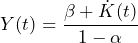
Once investment is determined, income is determined as well. Since investment can take only three values, three corresponding income levels follow. When net investment is zero,

when investment is at its upper level, , which corresponds to what Goodwin calls “the capacity of the investment goods industry”,

and when investment is at its negative level, , corresponding to wear and tear,
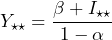
So income can take three different values, depending on the level of investment. What sets these regimes in motion, and makes them alternate, is the accelerator.
Switching Regimes
Things get a little trickier once we turn to the accelerator. In the standard version, investment responds to income changes through a fixed ratio — a mechanical link. Goodwin breaks this rigidity.
Firms compare the capital stock they actually have, , with the capital stock they would like to have, Ξ(t). In the simplest version of the model, we get

with κ the desired capital-output ratio. Crucially, this is the desired ratio, not the actual one in the economy. It’s precisely because the desired capital stock is never quite reached — with the economy forever chasing it — that fluctuations emerge. The originality lies in the adjustment rule.
Goodwin assumes that the economy reacts in sharply distinct ways depending on whether actual capital is below, equal to, or above desired capital. In modern notation:
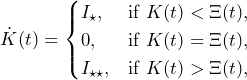
That sums up the second block of the model.
-
If we have

capital is insufficient. Firms invest at the top rate , and income rises to .
-
If we obtain

capital is excessive. Net investment turns negative at , and income falls to .
-
If we get

no net adjustment is needed, so

Goodwin’s own presentation is deliberately spare in this first version: actual capital is almost always either too low or too high relative to desired capital, and the economy moves by switching between these states rather than by converging smoothly to an equilibrium.
An Engine Running Without Fuel
Once the rule is written down, the cycle almost explains itself.
Suppose the economy starts with too little capital:

Then firms invest at rate , income jumps to , and capital stock rises continuously through time.
But that boom gradually eliminates the shortage that made it necessary. Actual capital catches up with desired capital. Once the target is reached and then exceeded, the regime flips.
Now we are in the opposite case:

Net investment becomes negative, income falls to , and capital stock begins to decline. Yet the slump also destroys its own basis: as excess capital is run down, the economy eventually returns to shortage, and the boom begins again.
Goodwin insists that this kind of nonlinear mechanism can maintain its own oscillation without relying on outside shocks, and that the nonlinearity keeps the system from either damping away or exploding indefinitely.
Below, I let the mechanism unfold in real time. Set , and the cycle appears in its pure form: income jumps between its high and low levels, capital rises and falls continuously, and the crossings between actual and desired capital trigger each reversal.
Under the Hood: Why Continuous Time?
I initially coded this in discrete time. Capital evolved step by step:

That is not, in itself, absurd. Many dynamic models are studied in discrete time. But here the key event is the crossing between actual and desired capital, and in Goodwin’s own setup that crossing belongs to a continuous motion. He describes the representative point as moving continuously along a branch, then switching regime at a critical point, while the capital stock itself does not jump.
That matters more than it may seem.
In continuous time, a regime switch usually occurs at a fractional instant. A boom may end at , not neatly at or . A discrete simulation that only checks the condition at integer dates will detect the switch late. At first, those changes may be very small — sometimes only a few hundredths of a time unit. If one observes the model only at integer dates, durations such as 4.264, 4.314, 4.354, and 4.404 may all be registered in exactly the same way for quite a while. The change is real, but the grid does not let it appear. In the simplest symmetric cycle, this may seem minor. But once the cycle is deformed by technical progress — the subject of the next post — the timing of those crossings becomes precisely what one wants to observe.
We gain a great deal by simulating the model in continuous time: it stays closer to Goodwin’s original formulation and makes visible features that a discrete approximation can easily blur.
The takeaway
Goodwin’s model is often remembered as a nonlinear cycle model, full stop. The mechanics are now clear: the cycle is generated by a moving threshold between actual and desired capital. The economy is always chasing a target, overshooting it, correcting, and overshooting again. This structure sets the stage for what comes next — and this is the less familiar part: the target begins to drift upward through time. This drift is the effect of technical progress as an exogenous constant force — and the pristine cycle does not emerge unscathed. The steady oscillation meets the relentless pressure of improvement, and the result is something quite different. To be continued!
Acknowledgments
Many thanks to Vincent Carret for his advice and assistance in implementing the code for this article, and to Michael Assous for his careful and invaluable feedback.